

By Nick Smith, 21st May 2023
Op-amps rarely capture the attention of audiophiles the way other components do.
Cables are luxurious & visually appealing, Digital Audio Players feature cutting-edge technology, and Earphones impact audio performance more than other components.
Contrast that with op-amps which feel somewhat antiquated, require electronics knowledge most of us don’t have to fully understand, and are only usable in a small number of portable products to begin with and their niche appeal is explained.
Yet there remains those of us in the audio hobby passionate in our devotion to portable amplifiers, eager to seek out new op-amps to enhance their performance and tilt their presentations in different directions.
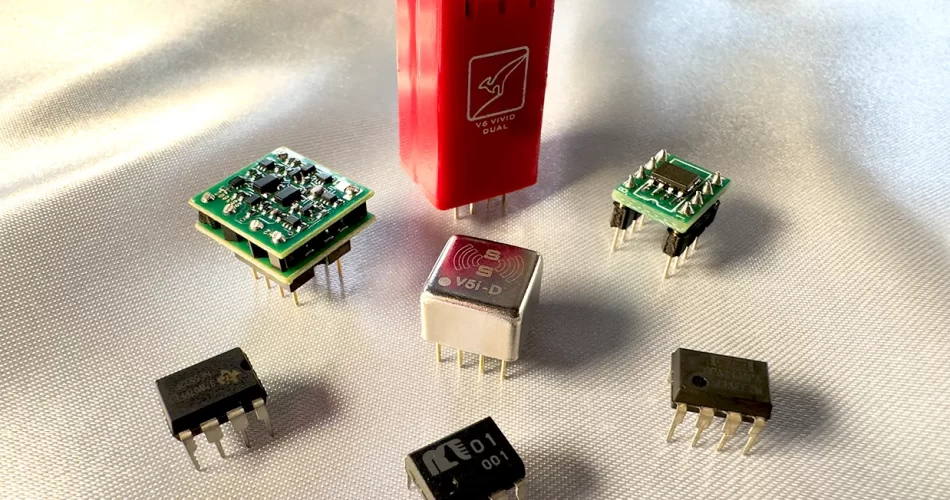
With this in mind I’ve assembled a small collection of Dual op-amps over the years, and have compared them back-to-back in the hope you may benefit from the knowledge when the time comes to make your next op-amp purchase – or perhaps generate the motivation you need to dive into portable amps for the first time.

Test System
The test system used for these comparisons consisted of a Cayin N8ii DAP set to solid state mode with P+ activated, hooked up via a 3.5mm Cardas Clear interconnect (clone of PWAudio’s 1950s cable) to a very heavily modified Little Bear B4-X portable amp.
From there a 2.5mm > 4.4mm Penon Totem adapter was attached to a NiceHCK BlackSoul cable, and connected to a set of Penon Impact IEMs with Spinfit W1 tips. Though inexpensive the BlackSoul synergises with the Impacts splendidly.

The Amplifier
I’ve owned & modified a number of Little Bear B4-X amps over the years.
The stock B4-X is pleasant sounding with nice tonality but has an extremely noisy background, and lacks resolution & refinement with poor channel matching.
This B4-X sounds nothing like the stock version. Here are a list of its’ mods:
- Vacuum tubes removed – the amp is now solid state, op-amp only
- Volume pot removed
- Voltage regulators replaced
- Bypass capacitors added to op-amps
- All capacitors replaced (this one has Elna Silmic IIs & Nichicon Fine Golds)
- All resistors replaced (this one has Takman metal films & Caddock MK132s)
- Signal path PCB traces cut & replaced with OCC silver litz wire
- Stock 1000 mAh battery replaced with external 5000 mAh battery
- Copper shielding tape applied to case interior

I would particularly like to thank DBaldock9 on the Head-Fi forums for his assistance over the years answering many of my modding questions.
Despite previously owning the Aroma A100TB, ALO Continental Dual Mono, ALO Rx & Vorzuge Pure II+, this modded B4-X is the most transparent portable amp I’ve owned. It does impart a somewhat V-shaped emphasis, but is impressively uncoloured and renders the sonic differences between op-amps readily discernible.
Impressions Overview
Context is important when it comes to audio impressions, so let me preface the shootout by stating I have not found the differences between op-amps to be night and day.
Instead the magnitude of changes between them are similar to what we might experience by swapping or upgrading IEM cables.
Now admittedly, going from a poor quality stock cable to a very expensive offering from a boutique brand like Effect Audio can potentially be a substantial change. However cable improvements on the whole are relatively minor, and synergy plays a large role in what we end up hearing – I find this also to be the case with op-amps.
One further point before we begin. I do hear a difference going from non-discrete to discrete op-amps, and would characterise that improvement (yes, I’ll use the word improvement rather than change in this instance) as a substantial uptick in refinement & naturalness.
Going from non-discrete to discrete op-amps felt slightly more pronounced than the differences between each of the non-discrete op-amps themselves, leading me to encourage upgrading to discretes if your budget & device can accommodate them.

Texas Instruments NE5532
The humble 5532, so often the included stock op-amps in budget amplifiers.
Having compared them closely to others in the shootout, the good news is they aren’t terrible. Well actually they sort of are, but if you never hear anything better you can live in blissful ignorance…. beware if you keep reading because there may be no going back!
The 5532’s sound congested, with a dry “mechanical” sound in which music doesn’t flow quite as well, and doesn’t sound as alive as it will with better op-amps. Bass is also fairly one-note and lacks a bit of impact, and each instrument sounds less distinct in the 5532’s congested stage than they do with better op-amps.
Having said that, I wouldn’t necessarily rush out to replace them if other links in your audio chain (particularly your IEMs) are lacking. They really only sound bad when you A/B them directly with more expensive alternatives.

Burr Brown OPA2134PA
The other non-discrete op-amps in the shootout perform at a vaguely similar level (appreciably above that of the NE5532) and the differences between them are largely a question of flavour.
Beginning with the OPA2134PA, this is a good all-rounder with a nice stage and resolution.
I found it to have better dynamics than the OPA1612, but not quite as dynamic as the MUSES01. It is less fatiguing than the MUSES01 however, seating the listener further back from the stage. It also emphasised bass more than the OPA1612, with perhaps a bit more lower midrange presence and slightly less upper midrange.

Texas Instruments OPA1612
I liked that these use adapter boards, so the pins aren’t as susceptible to bending like those of DIP8 op-amps like NE5532’s.
Sonically they’ve very nicely balanced but lack dynamics. Their stage may be a touch narrower than the MUSES01s, but they’re more polite and less fatiguing. They’re also a bit louder with more innate gain than the OPA2134PA, and in terms of sonic flavour feel like a safe choice.
They do have a little more upper midrange than the OPA2134PA, but are slightly more bass shy. Having said that, in the modded B4-X they impressed me the least of all the op-amps except the NE5532.

NJR MUSES01
These tied with the Burson V5i’s for my favourite non-discrete op-amps.
The MUSES01’s have a very upfront, in-your-face presentation that isn’t going to suit every system. One consequence is their stage is slightly narrow, however they have a significant amount of lower midrange warmth, better midbass than the OPA1612, and more midrange detail.
Indeed their forward midrange gives them a very exciting character, in which you feel very close to the stage. The downside is this can feel as though detail is being shoved in your face at times, which leads to fatigue.
I would absolutely recommend trying them, with the warning you may need to alter other components in your system to get the synergy right.

Burson V5i
Bursons have been quite well known in portable audio circles, and so may require less introduction than other shootout competitors.
Marketed as “hybrid” op-amps utilising both an IC chip & discrete components, they are not discrete op-amps nor do they sound like it, but are priced as if it were. However they are much smaller than any discrete op-amps available if space is a concern.
I found the V5i to have a stage as wide or wider than any of the non-discrete op-amps tested, with detail levels at least as high. They’re quite well balanced & non-fatiguing.
V5i’s are much less forward than the MUSES01’s, with a wider stage perception. V5i bass is slightly biased towards sub bass rather than midbass, and I would almost say a slight absence of midbass warmth helps them deliver a very clean presentation.
So far as technical performance goes, the V5i’s impressed me as much as any of the non-discrete op-amps, though I would hesitate to say they pull ahead. However I enjoyed the exciting character of the MUSES01’s a little more.
Unfortunately the V5i’s were no match for the discrete op-amps, and the gap between them was significant. V5i dynamics were flatter and the soundstage was not as spacious, with a more pronounced blobby left/middle/right perception rather than the stage feeling like a unified 3D space. The V5i’s also sounded more grainy and digital.
Do bear in mind these changes can be surprisingly difficult to pick up without A/Bing directly, so if your amplifier lacks the space for anything larger than V5i’s you can still enjoy all the resolution the rest of your system can deliver, discrete op-amps would mostly provide greater refinement.

SPARKOS LABS SS3602
With a footprint only slightly larger than non-discrete op-amps but sonic performance clearly a level above them, I now daily drive the SS3602’s in my B4-X, possessing the great virtue of being the only discrete op-amps I’m aware of that fit inside the stock case with the lid on.
Like the Burson V6 Vivids I’ll talk about soon, the SS3602’s feature a more spacious stage than the non-discrete op-amps, with a more refined presentation that feels less digital.
SS3602 dynamics are the best of any op-amp I’ve tested. Their midrange detail in particular is even higher than the V6 Vivids’ and they deliver more sub bass, but feel less spacious.
The downside of the SS3602’s is they deliver an overwhelming amount of detail, leading to an effect reminiscent of the Final A8000s in which like you feel like you’re hearing everything all at once – which can definitely lead to fatigue.
There’s almost a slightly metallic tinge to the sound, which perhaps suggests excessive upper midrange presence. This has the effect of requiring more careful album/track selection, and perhaps looking at system synergy as a way of alleviating it – replacing silver cables with copper for instance.
SS3602’s have been impressive given their form factor but may require careful pairing.

Burson V6 Vivid
If space and cost are not considerations, Burson V6 Vivids are my preferred choice.
These discrete op-amps delivered the most spacious, non-fatiguing and refined presentation of those in the shootout.
Interestingly I preferred the SS3602’s tuning, since the V6’s delivered less bass and were more laidback which I didn’t think suited the Penon Impacts and the rest of the system.
However, the V6’s featured more upper treble air than the SS3602’s and what felt like a slightly grander stage along with better imaging, with less feeling of ‘excessive’ detail being pushed towards me. There was a sense of effortless articulation from the V6’s none of the other op-amps could match, which in turn made the entire amplifier feel one step closer to the performance of a true high-end desktop component.

Conclusion
I’ve certainly learned why many audiophiles build massive op-amp collections. They’re a great way to tweak one’s system and come in all variety of sonic flavours.
Going from non-discrete to discrete is an appreciable step up, but the extra cost and especially size can be significant. If you have enough of both to spare I’d recommend it, if not you can stick with non-discrete and easily make up that performance difference in other parts of your system.
Having said that, my experience has been if you know how to DIY you may find simple changes to your amplifier circuit can deliver even larger sonic improvements for significantly less money. The problem with DIY of course is once you start modding things you’ll start seeing potential areas of improvement everywhere and before you know it your amp may look as Frankensteined as mine!
Seriously though, having more levers you can pull to obtain the precise sound you want is always a good thing and op-amps give you that extra dial to tweak your setup.
Now we just need more audio manufacturers releasing portable products with swappable op-amps, so the next generation of audiophiles can discover what they’ve been missing.
Thanks for the review!
I’m currently waiting for delivery of a
Sparkos 3602. I have been using 2604’s for some years, Looking
Forwards to it.
Not all Ne5532 are the same for example the sound of the NXP 5532a/BPA (ceramic) is not bad
Would love to see your thoughts on the Sparkos 2590’s
Miles better. Very good. I have em both. I use the 2590’s in my output stage on my dac.
I just recently bought a Geshelli Labs J3 DAC and upgraded the Op-Amps to Sparkos Dual Pro Discrete SS2950s. They took a while to burn in but what a difference! The sound stage opened up and the emphasis on detail is amazing.
Did you have to add anything to the SS2590 to install it? There was a note with my J3 that said I would have to add another part if I installed the 2590.
Sorry for the delay… Life!
No, but I was told by the Geshelli labs to order the pre-soldered PRO to DUAL DIP 8 adapter, but beyond that, nothing else.
Sorry, I meant to write the SS2590 OpAmp!
Is it safe just to replace the OpAmp, let say Sparkos with Burson, without concerning surrounding components?
I decided to A/B The Sparkos ss2590 and the new Burson Audio V7 Classic Pro Dual Opamp and I am finding that I like the Bursons even better than the Sparkos.
They are not as aggressively “In-Your-Face” and have a more relaxed, nuanced layering to their sound. They came highly recommended, and I agree!
I would have loved to destroy your psyche with a blind A/B test.
It seems to me that these comparisons are all anecdotal. I would like to see something a bit more scientific. If these devices vary as much as you suggest, in either phase, frequency or impulse response, these variations are measurable well beyond human hearing. Still, I am convinced the ear must be the final arbitrator, so long it is not colored by preconceptions and biases. In console preamps noise floor, headroom, and distortion are widely considered the most important concerns. Phase and frequency variations are most often the result of interactions with associated components rather than the chip itself.
Bizarre…
Op amps are very high gain, high input impedance, differential input, low output impedance, usually single ended, amplifiers. Principally, they are “fodder for feedback” as my electronics lecturer mused.
Their gain-bandwidth product is such that at very high closed loop gain, their bandwidth is very limited. Pile on the negative feedback, however and the usable bandwidth increases markedly, and distortion drops accordingly.
Op amps, like most electronic devices behave to a set of mathematical rules and any non linearities correspondingly reduce with the application of feedback. So it puzzles me how anyone can seriously claim to hear a musical difference between different op amp components. For instance, an NE5534AN op amp, aside from having a noise figure of 3.4nV/rootHertz and having an output stage that can drive into 600 ohms – useful properties for audio design – is no more “musical” than a battery or, say, an led, or a piece of wire.
I’d be fascinated to hear what science people who claim to be able to hear, let alone judge one op amp as being “sweeter sounding” over any other…
did you try? lol