


Penon Obsidian
Configuration: 4 wire, 24k gold plated OCC copper
Weight: 40g
Ergonomics: 7/10
Cost: $149
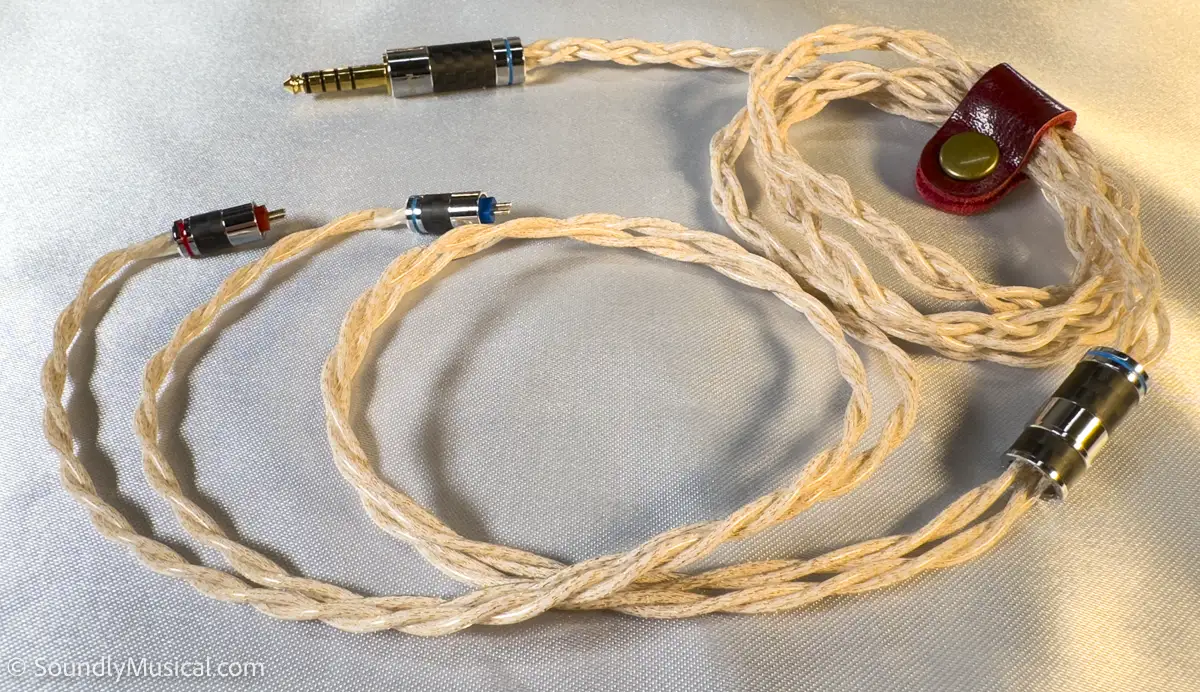
Penon Audio are no stranger to IEM cables, indeed their full range is massive and the Obsidian is but one of many.
They’re also no stranger to incorporating a variety of materials, and although the Obsidian’s gold-plated copper is by no means unique in the industry it’s one of the less common choices.
This particular Obsidian cable arrived as the stock cable for Penon’s Impact IEM – it is very similar to the original version available on Penon’s website, but the gold plating is 24k rather than 18k, and the cable features off-white rather than black insulation to more closely match the Impacts’ white faceplates.
So how does 24 carat gold make a cable sound? You’re about to learn.
Ergonomics & Build Quality
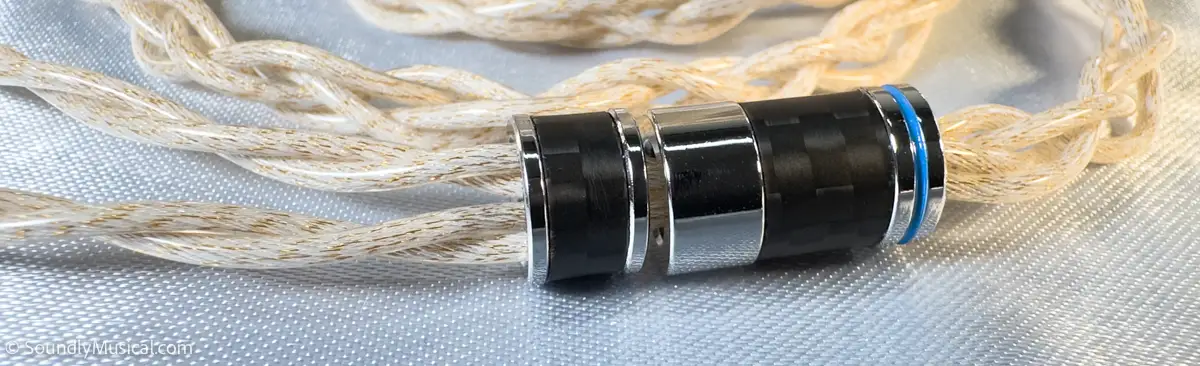
The Obsidian is surprisingly substantial & heavy for a 4 wire cable, though it is extremely flexible and drapes nicely in contrast with many of the stiffer cables in this shootout.
As a result of the extra weight the cable is more noticeable in use than say the Vocal or Ares S 4 wire, but pliable enough to be considered a comfortable cable in general. Indeed you may find the extra heft lends a greater impression of quality.
As for the Obsidian’s hardware, it is visually pleasing enough and the quality appears satisfactory for this price point without being exceptional. The Obsidian features a modular 2.5/3.5/4.4mm plug by default, but I asked Penon to supply mine with a 4.4mm connector as I’m not a fan of modular plugs in general.
Sound
The addition of gold lends the Obsidian a darker tonality particularly well suited to taming brighter IEMs, or simply those lacking in midrange richness.
Indeed I find the Obsidian to be something of a vocal specialist, adding a satisfying sense of fullness with impressive dynamics for a 4 wire cable. V-shaped IEMs which may otherwise lack refinement can particularly benefit here.
Where the Obsidian perhaps lacks in comparison to more expensive cables is in the area of soundstage expansion, where it seems to widen the stage less effectively than some other cables, particularly those containing silver.
IEM Comparisons
Penon 10th Anniversary
Dynamics are a strength of this pairing, and the Obsidian also thrusts the midrange (and vocals correspondingly) forward in a manner well suited to vocal genres.
Unfortunately the soundstage feels rather narrow, almost leading to a feeling of claustrophobia, leading to an unsuccessful pairing.
ISN EST50
The Obsidian & EST50s feel made for each other, delivering refined, smooth vocals that are somewhat lacking on the stock S8 cable, with the same great dynamics of the 10th Anniversary pair up.
Even the soundstage feels quite wide which is not something I expected from the Obsidian, and thanks to a more prominent lower midrange & midbass music feels more crunchy and visceral. Bass impact does seem slightly lower, but the EST50s have plenty to spare.
Compared with Penon’s Vocal cable on the EST50s the Obsidian sounds cleaner & more controlled whereas the Vocal feels a little more upfront & aggressive.
Penon Impact
As the Impacts’ stock cable, I feel Obsidian is largely responsible for them garnering less attention among high-end IEM collectors than they might otherwise deserve. Whilst it’s possible Penon chose this cable to keep the Impacts’ price down, to me the pairing is not ideal.
The Obsidian is a midrange-centric cable, already a strength of the Impacts’ which I’d argue they require no further assistance in. Conversely the Impacts’ greatest weakness vs similarly-priced IEMs may be their slightly narrow soundstage, which Obsidian does not do enough to rectify. Paired with Obsidian the Impacts feel excessively vocal-oriented, unlikely to perform as impressively with non-vocal genres.
It’s saddening to think anyone who tries the Impacts with the stock Obsidian cable may walk away without grasping what they’re fully capable of.
Verdict
I was initially unimpressed with the Obsidian as the Impacts’ stock cable, but it’s excellent performance with the EST50s has redeemed it to some degree. This is a solid option if you need to extract more midrange body from your IEMs.
Where I feel the Obsidian suffers is simply by comparison with the Vocal – which is lighter, and costs less than half as much. I’ve found these two cables similar enough that having both feels somewhat redundant, and my sonic preference leans towards Vocal.
Obsidian does have the virtue of lacking Vocal’s ostentatious appearance (particularly the black Obsidian version), so if you intend to use your cable on public transport or in a busy office perhaps that’s worth keeping in mind.
Introduction
Cable 1 & 2 – EA Ares S 4 Wire & 8 Wire
Cable 3 – Effect Audio Cadmus 8 Wire
Cable 4 – Effect Audio Code 23
Cable 5 – ISN S8
Cable 6 – Liquid Links Martini
Cable 7 – Liquid Links Venom
Cable 8 – NiceHCK BlackSoul
Cable 9 – Penon CS819
Cable 10 – Penon Leo Plus
Cable 11 – Penon Obsidian
Cable 12 – Penon Vocal
Cable 13 – DIY Cardas Clear
Cable 14 – DIY Hakugei Gray Dragon
Cable 15 – DIY Hakugei Sky-Sea Voice
Talking Point – Cable Performance vs Ergonomics
Talking Point – Cable Value
Talking Point – Cable DIY
Cable Awards
Conclusion
Cable Manufacturer Links & Acknowledgements
Comments